The quick answer
Foods don't contain nitric oxide itself, but some help your body make it. The best are nitrate-rich vegetables (beets, arugula, spinach, celery), citrulline-rich watermelon, arginine-rich nuts and seeds, plus garlic, pomegranate, cocoa and vitamin C-rich citrus that help protect it. They are excellent for men's circulation — but you need generous amounts every single day. Boostaro puts the key blood-flow nutrients, led by L-citrulline and pine bark extract, into one capsule twice a day.
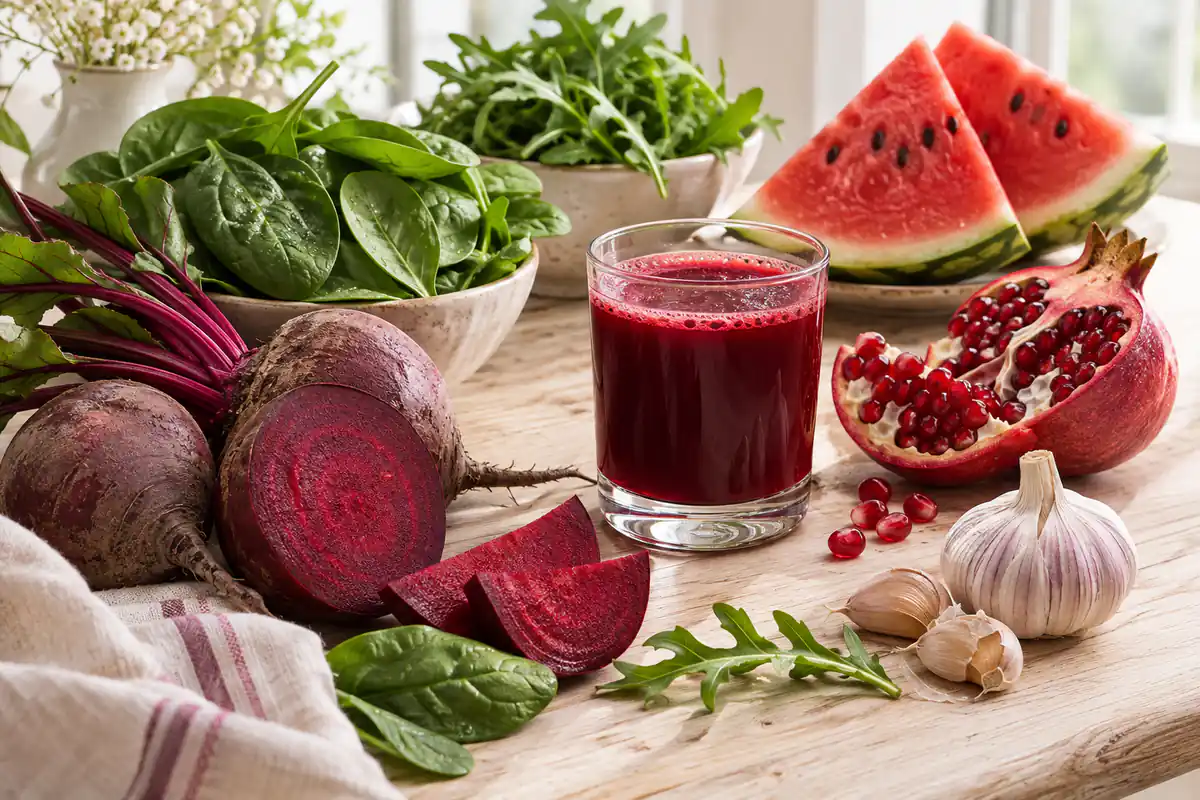
Nitric oxide has gone from a biology-class term to one of the most searched topics in men's health, and searches for nitric oxide foods have roughly tripled in the last few weeks. There is a good reason: nitric oxide is the molecule that tells your blood vessels to relax and widen, and healthy blood flow is the foundation of energy, workouts and male performance. The good news is that your plate can help. The honest news is how much of it you would need. Here are the nine foods that matter most, what each one does and the simplest way to keep the habit going.
First, a quick explainer: how food becomes nitric oxide
Nitric oxide (NO) is a gas your body produces on demand and breaks down within seconds, so you cannot simply eat it. Instead, foods support it through two main routes:
- The nitrate route. Vegetables like beets and leafy greens are rich in dietary nitrates. Friendly bacteria in your mouth convert nitrate to nitrite, and your body turns nitrite into nitric oxide.
- The amino acid route. The enzyme that makes nitric oxide in your blood vessels uses L-arginine as raw material. L-citrulline, found in watermelon, is converted into L-arginine in the body, which keeps that supply topped up.
A third group of foods doesn't produce nitric oxide but protects it: antioxidants like vitamin C and plant polyphenols help nitric oxide last longer before it breaks down. With that in mind, here is the list.
9 foods that support nitric oxide and healthy blood flow
| Food | What it brings | How it helps | The daily reality |
|---|---|---|---|
| Beets & beet juice | Dietary nitrates | Nitrate → nitrite → nitric oxide | A glass of juice or a couple of beets, every day; earthy taste, stains everything |
| Arugula | One of the richest nitrate sources | Nitrate route | A big handful or two daily |
| Spinach & leafy greens | Nitrates, magnesium | Nitrate route plus vessel support | Large salads every day; greens wilt fast |
| Celery & lettuce | Nitrates | Nitrate route | Easy to add, but you need volume |
| Watermelon | L-citrulline | Citrulline → arginine → nitric oxide | Several cups a day for a meaningful amount; seasonal |
| Nuts & seeds | L-arginine, magnesium | Raw material for nitric oxide | A daily handful; calorie-dense |
| Garlic | Sulfur compounds | Supports the nitric oxide enzyme | Fresh cloves, crushed, most days |
| Pomegranate | Polyphenols | Helps protect nitric oxide | Juice is sugary; seeds are a chore |
| Citrus & dark cocoa | Vitamin C, flavanols | Antioxidant protection | Easy, but high-cocoa chocolate is bitter |
1. Beets: the nitrate superstar
Beets are the poster child of nitric oxide foods, and with good reason: they are one of the richest dietary sources of nitrates, which is why beet juice became popular with endurance athletes. A glass of juice or a couple of roasted beets is the typical daily amount people aim for. The drawbacks are practical: the earthy taste, the purple stains and the fact that juice has to be bought or made fresh.
2–4. Arugula, spinach, celery and other leafy greens
Arugula is a surprise champion, often ranking even higher than beets for nitrate content by weight. Spinach, lettuce and celery add more nitrates plus magnesium, which supports normal blood-vessel function. The catch is volume: you need generous salads every day, and fresh greens spoil within days.
5. Watermelon: nature's L-citrulline
Watermelon gave L-citrulline its name (from Citrullus, the watermelon genus). Your body converts citrulline into L-arginine, keeping the raw material for nitric oxide topped up. It is refreshing and easy to love, but the amount per serving is modest, so getting a meaningful daily dose from fruit alone means eating a lot of watermelon, every day, in every season.
6. Nuts and seeds
Peanuts, almonds, walnuts, pumpkin and sunflower seeds provide L-arginine directly, along with magnesium. A daily handful is a great habit, as long as you keep an eye on the calories.
7–9. Garlic, pomegranate, citrus and dark cocoa
These are the protectors. Garlic's sulfur compounds support the enzyme that makes nitric oxide; pomegranate polyphenols, vitamin C from citrus and flavanols from high-cocoa chocolate act as antioxidants that help nitric oxide last before it breaks down. Vitamin C also matters for collagen, the protein that keeps vessel walls strong and flexible.
The honest part: what a full "nitric oxide diet" asks of you
None of these foods is a trick — they are genuinely good for you, and every man over 40 would benefit from eating more of them. The challenge is doing it every day: beets or juice, a big bowl of greens, several cups of watermelon, a handful of nuts and fresh garlic. That is a serious shopping list, food that spoils quickly, seasonal gaps and a lot of prep. Most men start strong and drift within a couple of weeks, and the benefit fades with the habit.
It also leaves gaps. Food rarely delivers meaningful amounts of nutrients like maritime pine bark extract, vitamin K2 or nattokinase, which are part of many modern circulation formulas.
The simpler route: the key nutrients in one capsule
This is where a well-built formula earns its place. Instead of chasing nine foods, you take the nutrients that matter most for the nitric oxide pathway, in measured amounts, every day:
- L-citrulline — the watermelon nutrient, without the watermelon.
- Maritime pine bark extract — polyphenols most often paired with L-citrulline for circulation.
- Vitamin C and L-lysine — collagen support for strong, flexible vessel walls.
- Magnesium — the leafy-green mineral, for normal vessel function.
- Vitamin K2 and nattokinase — two nutrients that are hard to get from a typical diet, for healthy arteries and circulation.
Our recommendation: Boostaro
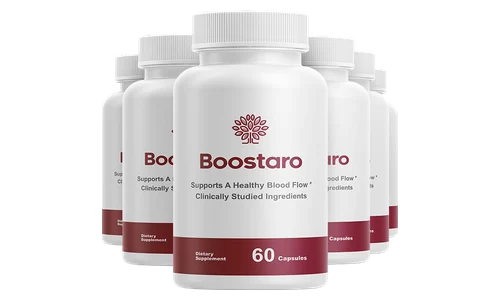
If you love the idea of a nitric oxide diet but know you will not eat beets, a bowl of arugula and several cups of watermelon every day, Boostaro is the option we recommend. It brings the core blood-flow nutrients together — led by L-citrulline and maritime pine bark extract — in one capsule twice a day, and its label says it plainly: "Supports A Healthy Blood Flow*". Keep eating your greens; let the capsule cover the consistency.
- Simple: one capsule twice a day with water. Nothing to mix, measure, juice or fizz.
- Focused: the label says it plainly: Supports A Healthy Blood Flow* — the circulation side of male performance.
- Seven-ingredient formula: L-citrulline, maritime pine bark extract, vitamin C, L-lysine, magnesium, vitamin K2 and nattokinase.
- Made with care: made in the USA in an FDA-registered facility that follows GMP guidelines, and third-party tested, according to the maker.
- Fair pricing: one bottle $69, three bottles $177 ($59 each), six bottles $294 ($49 each) — + shipping on 1 bottle, FREE shipping on 3 and 6 bottles.
- Bonuses: the maker includes a digital copy of the e-book The TRUTH About Erectile Dysfunction and access to its private VIP client area (guides and recipes the maker values at $297).
- Low risk: a 60-day, 100% money-back guarantee on every order.
Our recommendation
The maker asks for at least 30 days of daily use, and each bottle is a 30-day supply. That is why we suggest the 3-bottle package ($59 per bottle, free shipping) or the 6-bottle package ($49 per bottle, free shipping): enough for a fair, consistent run, all covered by the 60-day money-back guarantee.
Habits that help your body make more nitric oxide
- Exercise regularly. Movement itself stimulates nitric oxide production in your blood vessels.
- Skip antibacterial mouthwash. Mouth bacteria help convert dietary nitrates; strong mouthwash can wipe them out.
- Sleep well and don't smoke. Both protect healthy blood vessels.
Curious about the viral shortcuts? We looked at one in detail: the baking soda trick for men.
The bottom line
The best nitric oxide foods for men are beets, leafy greens like arugula and spinach, watermelon, nuts and seeds, garlic, pomegranate, citrus and dark cocoa. They genuinely support healthy blood flow — if you eat enough of them every day. For most men the hard part is not knowing what to eat, it is keeping it up. A daily capsule built around L-citrulline and pine bark, like Boostaro, makes that consistency simple.
Frequently asked questions
What foods are highest in nitric oxide?
No food contains much nitric oxide itself, because it is a short-lived gas your body makes on demand. The foods that support it best are nitrate-rich vegetables (beets, arugula, spinach, celery, lettuce), watermelon for L-citrulline, nuts and seeds for L-arginine, and garlic, pomegranate, cocoa and vitamin C-rich citrus, which help protect nitric oxide once it is made.
What is the fastest way to increase nitric oxide naturally?
Nitrate-rich foods such as beet juice and leafy greens act relatively quickly, while L-citrulline supports your body's own nitric oxide production over consistent daily use. Regular exercise, good sleep, not smoking and avoiding antibacterial mouthwash (which disrupts the mouth bacteria that help convert nitrates) all help too.
Is watermelon good for nitric oxide?
Yes. Watermelon is the best-known natural source of L-citrulline, an amino acid your body converts into L-arginine and then into nitric oxide. The catch is quantity: the amount of citrulline in a serving is modest, so getting a meaningful daily intake from fruit alone means eating a lot of watermelon every day.
Are nitric oxide supplements for men worth it?
For men who want consistency, yes. A good formula delivers measured amounts of the nutrients behind the nitric oxide foods without the daily shopping and prep. Boostaro, for example, combines L-citrulline and maritime pine bark extract with vitamin C, L-lysine, magnesium, vitamin K2 and nattokinase, and comes with a 60-day money-back guarantee.
Can nitric oxide foods interact with medication?
Normal food amounts are fine for most people. But if you take nitrate medication, blood-pressure medicine or blood thinners, talk to your doctor before adding concentrated beet products or any circulation supplement, since they work on the same blood-vessel pathway.